

Barbeques
 Japanese Konro grills are one of the most iconic items of cookware. Usually either rectangular or round in shape, these clay barbecues are predominantly used in traditional indoor spaces, making them the perfect choice for a spectacular Yakitori dinner party. Using either skewers or a metal mesh, they are suitable for cooking a huge variety of vegetables, meat, and seafood. By using traditional Binchotan coal, which is largely smoke-free, they create an unmatched flavour. Please see the product information or contact us for directions for use.
Donabe
 Donabe (literally “earthenware pot”) are pots made from traditional Japanese clay for use over an open flame. Traditionally, food is often cooked at the table, such as shabu-shabu. Donabe pots are usually glazed on the inside and porous on the outside. Unlike a lot of earthenware cookware, Donabe pots can be used over an open flame as well as in the oven (ensuring that the outside of the pot is dry and the pot is gradually preheated beforehand). With proper use, these pots can last for decades, some even surviving for centuries. A newly acquired Donabe pot should be used to boil and simmer water for a few hours and thoroughly dried before being used for cooking. They are available in small sizes for individual use as well as large sharing sizes. It is said that rice cooked in a Donabe pot is better than any other cooking method.
Frying Pans
 Frying pans are one of the most widely used and versatile items of cookware in our kitchens – and some use them for everything. But did you know that cooking different things requires different pans? Some materials are more suitable for certain foods and cooking methods than others. In short, the rule of thumb is: If what you’re cooking is likely to be sticky (like eggs), and requires a mid-to-low heat, then non-stick is a perfect choice. If cooking acidic foods, such as tomatoes or lemons, then stainless steel is the best choice, as it is a non-reactive material. If stearing or frying on high heat, for example for stir-fry dishes, then cast iron or carbon steel are best.
Non-stick pans
In general, non-stick reacts badly to high heat, so to preserve the life of the coating, use on a mid-to-low heat, and remember to always use plastic, nylon, or wooden utensils to avoid scratching the surface. Our range of coated frying pans is PFOA-free, meaning they will not give off harmful material into your food. We carry a huge range of sizes and types.
Stainless Steel
Many professional cooks also swear by stainless steel pans – they are long-lasting and hardy, often lighter than cast iron pans, and are completely non-reactive (which is great when deglazing a pan using an acidic substance like wine or lemon juice). If you’re browning meat, cooking on medium heat, or prefer metal utensils, then stainless steel is your friend. It also creates a fantastic and tasty fond with which to make a pan sauce, which is a big plus. The best stainless steel pans are heavier, as they will have a core of highly conductive metal, like aluminium, sandwiched between the stainless steel. This helps to conduct heat evenly all over the pan, which helps with even cooking. Think stainless steel is hard to keep clean? Think again. The trick with using stainless steel is to heat to high heat, turn down, and put a drop of oil into the pan and swirl around. Leave it for a minute or so, to cool off the almost smoking point, and then add food, and a little more oil if necessary. This allows the heat and oil to close the microscopic pores in the pan, making it much less prone to food sticking semi-permanently. This should be done every time the pan is used, as cooling and washing will open up those pores again.
Cast iron
Need a good sear? Cast iron is your man as it transfers heat very efficiently and is therefore great for cooking steaks. Cast iron is heavy and heats evenly. It transfers heat extremely efficiently and holds heat for longer periods. Because it is so efficient, it should also be used at a mid-to-low heat, and will sear a steak beautifully – just allow time for the pan to heat first, and add food when it is hot. The cast iron doesn’t react particularly well with acids, like wine, so if you plan to deglaze, use a stainless steel pan instead. To clean after cool, scrub with a sponge and natural abrasive, like salt. Store with a light film of cooking oil to prevent rust spots from forming. A very important for cast iron is that your pan is properly seasoned (or enameled). There are many ways to season a cast iron pan – some say you should cook only bacon in a new pan for the first year, or bake it covered in fat several times before use. To season an old pan, scrub away any rust and crusted on food, and allow to dry completely. Rub with a thin layer of oil and put into a cold oven. Turn the heat to 180°C, with the pan inside. Allow to bake at 180°C for 30 minutes, and cool in the oven. When cool, wipe dry with paper towels, and the pan is ready for its first use. The non-stick patina will increase every time oil or fat is heated in the pan and will get better and better, provided the pan is not scrubbed with water. If a thorough washing is required, re-season. Seasoning like this can be done as many times as you like, and will only improve the surface of the pan. So whenever you have the oven on for something else, put the pan in at the same time. All this is, of course, not necessary for enameled cast iron cookware – just the plain cast iron.
Carbon Steel
Like cast iron, carbon steel pans become increasingly non-stick over time, without the need for special coatings during manufacturing. In use, carbon steel pans are thinner and lighter than cast iron pans and are also more responsive to temperature changes. Just like cast iron, carbon steel pans require the first seasoning before use. For instructions on this, please check our Materials Buyers Guide.
Griddles
 A griddle pan, where the pan’s base has raised ridges, will provide beautiful char marks; unlike the oven, it will flash-fry steaks and veg in no time.
You’ll want something with deep troughs and tall peaks, which provide greater char marks and allow the fat to render into the grooves, ensuring your food isn’t cooked directly in it. Shallower grooves lead to faint char marks, or even none at all, and a greasier end product.
Griddle pans fall into two main categories: cast iron and non-stick, usually on an aluminium base. There are pros and cons to each, though overall we would recommend cast iron griddle pans.
Cast iron pans are usually made of one lump of moulded iron. Some are enameled, which means they are easier to clean and a little more ‘nonstick’; while others aren’t, and require seasoning (basically they always need to be dried and oiled after use).
Cast iron pans have great heat retention, far better than the nonstick ones, but they take longer to heat up. It’s worth waiting, however, as your steak will cook evenly and quickly once it’s in the pan.
As for the ridges, cast iron pans tend to offer higher ridges than nonstick. This is because nonstick pans are normally made of a sheet of a single aluminum sheet, which can tear or deform if the ridges are too high. As a consequence, cast iron, because it’s hotter and has bigger ridges, provides much better sear marks – look for peaks of about 5mm or more.
Omelette Pans
 The Japanese Omelette Pan is perfect for tamagoyaki, a Japanese rolled egg omelet commonly eaten in bento boxes or as nigiri sushi. The traditional rectangular shape allows for a perfectly shaped roll. They are typically made from carbon steel.
Saucepans
 The term “saucepan” encompasses a wide range of cooking pans these days, but in general, it is a deep pan, usually lidded and in a variety of sizes and materials for different cooking tasks. It is generally an all-rounder for preparing food – from soups and stocks to searing meat and boiling or steaming vegetables. Saucepans usually have a long handle on one side and can also feature a short grip on the opposite side to allow for easy lifting. Our range of saucepans comprises a huge variety of shapes and sizes, some of them with detachable handles to allow for oven use and serving. A good quality stainless steel saucepan will have at least one inner core of aluminum to create even and speedy heat conductivity. Copper saucepans are also available.
Saute Pans
 A saute pan is a specialist piece of kit, but one you will use regularly. They have a large flat bottom and tall straight sides, allowing more efficient heat evaporation. Usually used with a lid, they are perfect for slow frying when you want to preserve moisture. It is one of the most useful pans in your kitchen, so it’s worth investing in one that will last. Our range of saute pans is made from the highest quality stainless steel with inner cores of aluminium for greater and even heat conductivity. Available in both uncoated and non-stick coated. They are also available in copper.
Steamers
 Steamer pots are similar to stockpots but include a tiered system of insets with holes in the bottom. Steam rising from boiling water in the base pot will allow your food to be gently cooked for a perfectly tender and flavourful dish. It is perfect for cooking vegetables and fish.
Stockpots & Casseroles
 Stockpots are large, deep pots used to make anything from stock, soup, stew, chili, to boiling noodles, pasta, corn, vegetables, and seafood. Commonly made of stainless steel, Stockpots are available in a variety of sizes for general home use and larger sizes for commercial use.
There are several different types of Stockpots and pot components and some are made in a multi-pot system of an outer pot that holds a slightly smaller inner steamer pot or strainer. They typically have two grip handles on either side to allow for easy lifting and removing from heat.
The width of many Stockpots will vary so when selecting, consider the value of having a wider rather than narrow width pot. The wider pot will allow for easier stirring, working with food ingredients, and cleaning. Wider widths may also be better for storage rather than having to store a taller standing pot. Materials used in the construction of our range of pots are comprised of stainless steel with an aluminum core for efficient and even heat transfer. Aluminum core pots will be heavier in weight and thicker in substance, which will assist with keeping foods from burning easily, a problem that may occur with lighter weight construction.
Casserole Pots are similar to stockpots but are typically shallower. It is also suitable for use in the oven as well as a serving dish. Usually made from uncoated or enameled cast iron, they can last for generations, and with excellent heat retention, are your secret weapon when it comes to cooking better for longer
Woks
 Woks are incredibly versatile cooking pots, originating in China. In Japan the wok is called a chukanabe (literally “Chinese pot”). It is one of the most common items of cookware in most of East and Southeast Asia and is fast gaining popularity in Western homes, as more people enjoy cooking oriental food.
A traditional wok is round-bottomed, which is ideal for cooking over an open fire pit. However, models with flat bottoms are prevalent in the West where more homes have electric or induction hobs with flat glass surfaces.
Woks are ideal for stir-frying, steaming, pan-frying, deep-frying, poaching, boiling, braising, searing, stewing, making soup, smoking, and roasting nuts – anything you could think of!
Variations of styles we offer at The Japanese Home include models with one long handle (to avoid burning hands when stir-frying and tossing over very high heat), one long handle with a short grip on the opposite side (for easy handling of larger sizes), and models with short grips on both sides (ideal for steaming, braising or making soups). They also come either with or without pouring spouts.
Japanese Knife Company · The buying guide
Cookware buying guide.
Better cooking starts with the right pan. Find the material, shape and size that fit the way you actually cook.

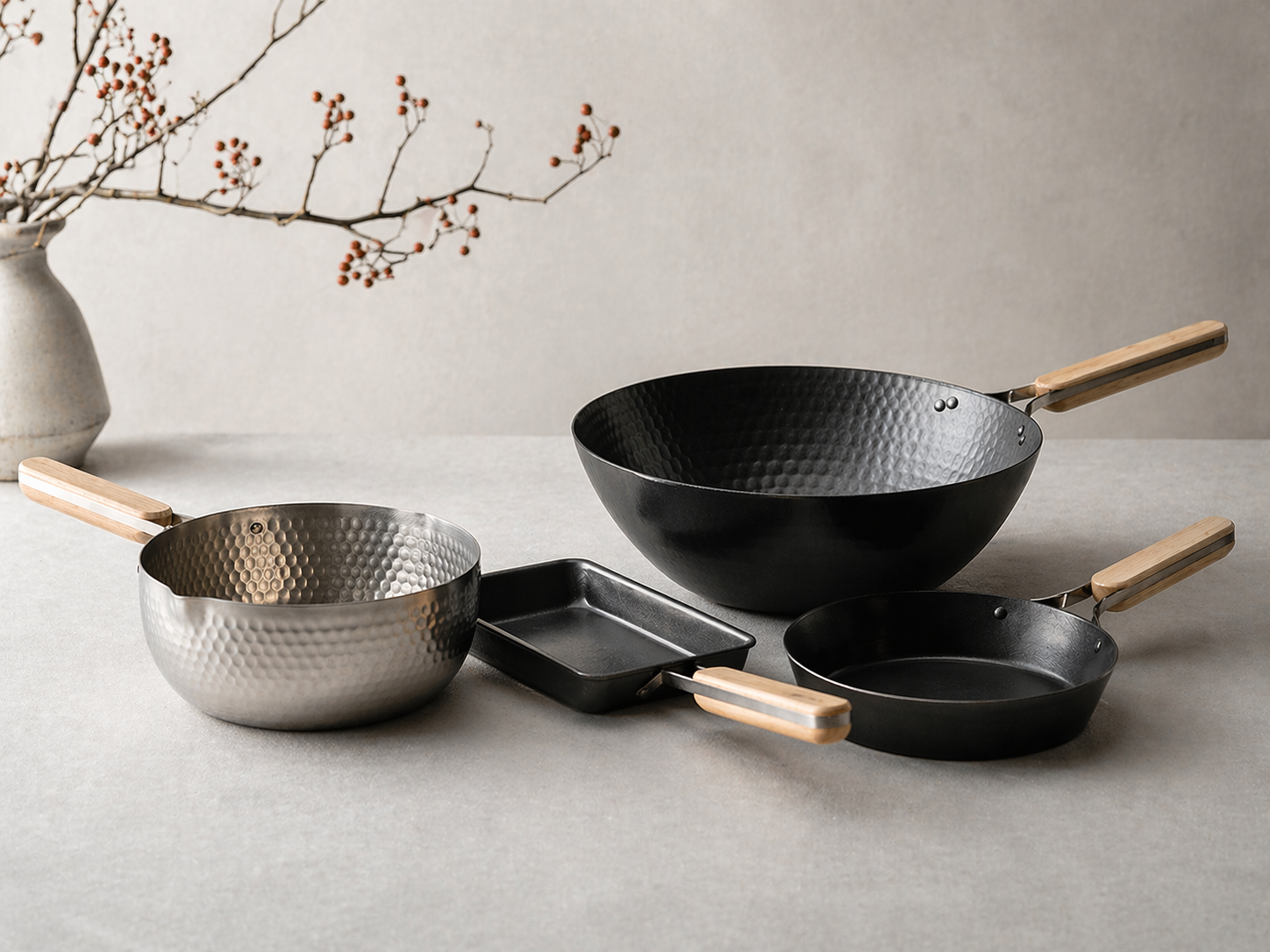


Buying your first pans?
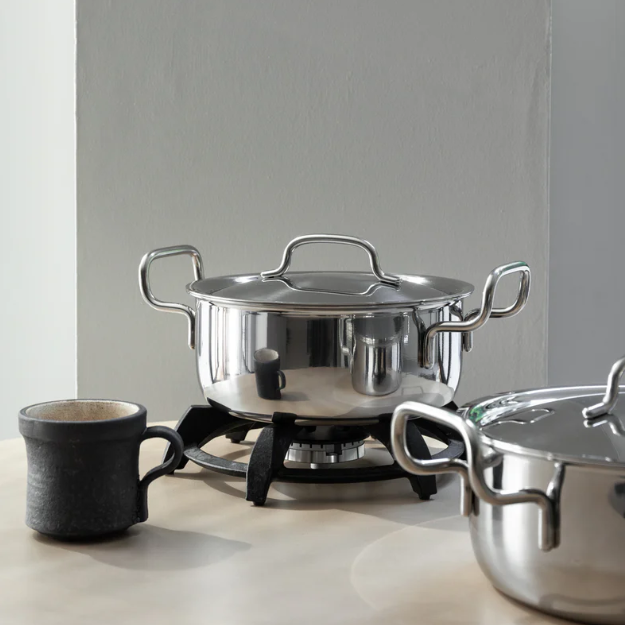
Start with a 24–28 cm stainless steel frying pan and a 2–3 litre stainless saucepan — both with an aluminium or copper core for even heat. Add one non-stick pan for eggs, then a cast iron skillet or a stock pot as your cooking grows. Match the pan to your hob (especially if it’s induction), and build the collection around the food you actually cook.
The best pan is personal.
Choose by material first — it decides how a pan heats, whether it reacts with food and how you care for it. Then pick the shape for the job, the size for your hob and household, and the finish you want to look after.
Material before shape
How a pan heats and behaves comes from what it’s made of. Decide the material before the size or style.
Buy for the job
Match each pan to a task you do often. A few well-chosen pieces beat a boxed set of pans you never use.
Weight is a clue
The best stainless and copper pans are heavier because they carry a conductive core. Solid usually cooks more evenly.
Care you can keep
Choose a pan whose upkeep suits you. Cast iron and carbon steel reward seasoning; stainless is the low-effort all-rounder.
Four questions. A clearer choice.
What do you cook most?
How much upkeep do you want?
What’s your hob?
Budget for your main pan?
The finder suggests a category to explore, not a guaranteed product. Geometry, hob compatibility and stock still matter — ask us to confirm a specific pan.
Twelve pans. A purpose for each.
Once you’ve chosen a material, the shape does the rest. Each type below is matched to the categories in our shop, with what to check before you buy. Sizes are common shopping ranges, not rules.
Frying Pan / Skillet
The pan you’ll reach for daily — frying, searing and browning. Sloped sides make it easy to toss and slide food out.
Saucepan / Milk Pan
The deep, lidded all-rounder for boiling, simmering sauces and steaming. Smaller milk pans give gentle control for milk, custards and melting.
Sauté / Chef Pan
A wide, flat base with tall straight sides — ideal for browning then simmering in the same pan. Used with a lid for risottos, curries and braises.
Casserole / Stew Pot
Wide, deep and lidded for stews, curries and braises that improve with time. Enamelled cast iron holds a steady simmer for hours and goes oven to table.
Stock Pot / Soup Pot
Tall and deep for stock, soup and pasta — plenty of water returns to the boil quickly and keeps pasta from sticking. A core stops big volumes scorching.
Wok / Stir-Fry Pan
Versatile for stir-frying, steaming and deep-frying. Round-bottomed woks suit an open gas flame; flat-bottomed versions work on Western and induction hobs.
Tamagoyaki / Omelette Pan
The Japanese rectangular pan for tamagoyaki — the rolled egg omelette in bento and sushi. Its shape forms an even roll; traditionally seasoned carbon steel.
Yukihira Pan
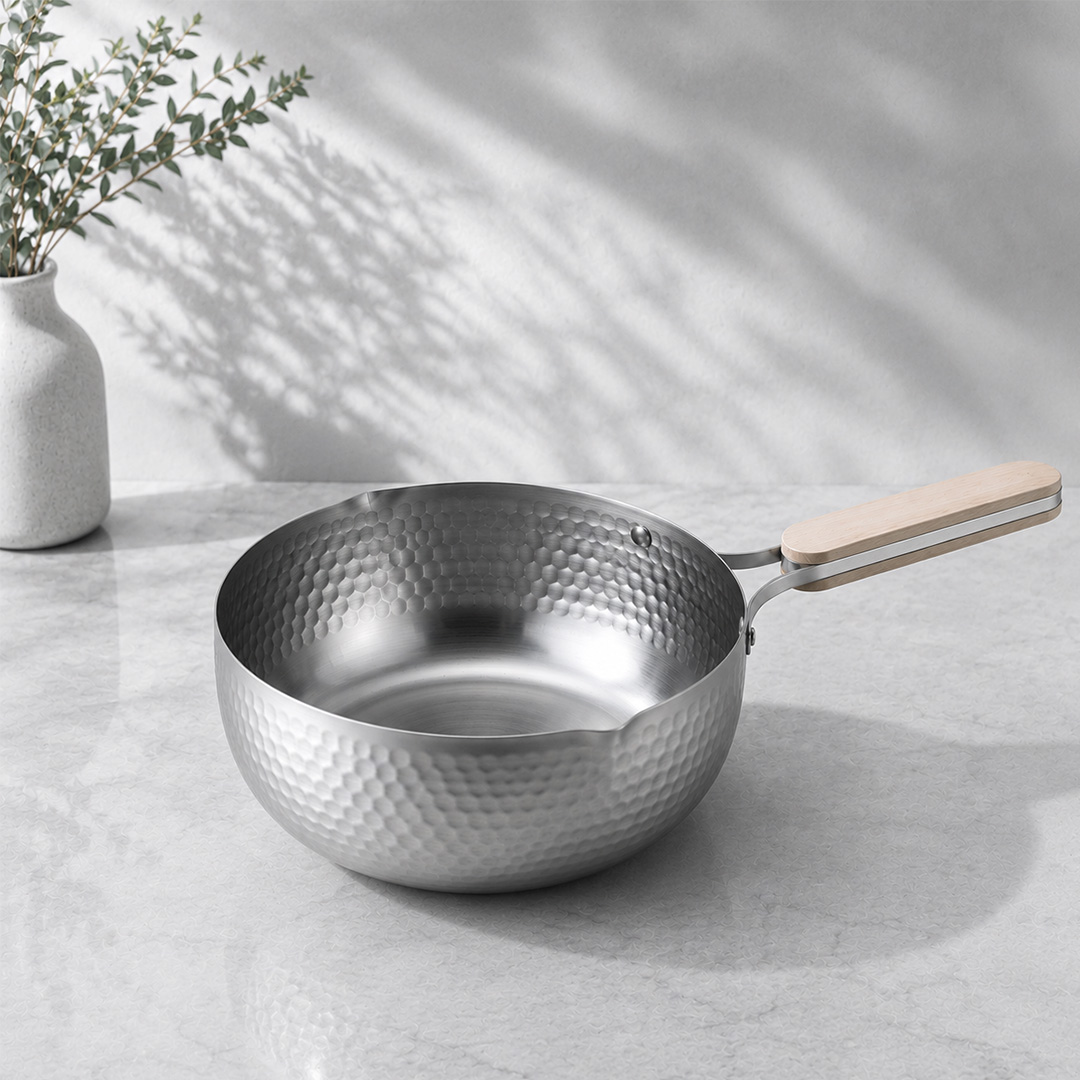
A lightweight, one-handled Japanese pot, hand-hammered from aluminium or stainless. The dimpled surface spreads heat quickly and evenly, with dual spouts for pouring.
Steamer
Tiered baskets over boiling water gently cook food until tender — ideal for vegetables, fish and dumplings, keeping colour, texture and flavour.
Griddle / Roasting Pan
Ridged griddles give char marks and let fat drain; flat griddles suit pancakes and flatbreads. Cast iron gives the best sear and holds heat across a large surface.
Donabe
The traditional Japanese clay pot for an open flame — used for hot-pots and table cooking. Rice cooked in a donabe is prized, and a good one lasts decades.
Charcoal BBQ Grill
The Japanese clay konro barbecue for yakitori. Smoke-free binchotan charcoal with skewers or a mesh brings unmatched flavour to meat, seafood and vegetables — even indoors with ventilation.
These are typical illustrations, not scale drawings. Actual dimensions, base type and hob compatibility vary by maker — always read the product specification alongside the shape.
Stainless or non-stick? You’ll want both.
They do different jobs. Most kitchens keep a stainless pan for browning and sauces, and one non-stick pan for eggs and delicate foods.
Choose stainless if…
- You want
- To brown and sear, then make a pan sauce from the flavourful bits left behind.
- You cook
- Acidic foods — tomato, wine, lemon — which non-stick and bare iron dislike.
- Check
- An aluminium or copper core (heavier is better), and heat the pan before adding oil to stop sticking.
Choose non-stick if…
- You want
- Eggs, pancakes and fish to release cleanly, with little oil and easy cleaning.
- You cook
- Low-and-gentle. High heat and metal utensils shorten a coating’s life.
- Check
- It’s PFOA-free, and treat it as a consumable — even good coatings wear out and need replacing.
Read the pan, not just the label.
Two pans in the same material can behave very differently. What’s inside the walls and base, and how heavy it is, tell you more than the marketing.
The core does the work
Steel and glass conduct heat poorly on their own. Good stainless pans bond a layer of aluminium or copper into the base and walls — that core, not the steel, gives even heat. Heavier usually means more of it.
The base decides the hob
Induction only heats magnetic materials. A pan works on it if a magnet grips the base — so copper, aluminium and glass need a bonded magnetic plate. Check before you buy.
Weight and balance
A heavier pan holds heat and sits stable, but must be liftable when full. Check the handle stays cool or is oven-safe, and that it feels balanced in your hand.
What size do you actually need?
Pan size is measured across the top rim; pots are measured by capacity. Your household and hob matter more than owning the biggest pan.
Every cookware material.
The choice that shapes everything else. Start with the care routine you can keep, then compare how each material heats, whether it reacts with food, and where it shines. These are practical guides, not laboratory rankings.
Material names are a starting point, not proof of a finished pan’s quality — construction, the core and the maker matter just as much. Browse all cookware by material →
If you cook one kitchen’s style.
Cook one cuisine more than others? A few well-chosen pieces cover almost everything you make. Each links to the relevant cookware in our shop.
What’s happening inside the pan?
A good finish is worth enjoying — just understand which part actually does the cooking, and how the pan is built to last.
Clad & multi-ply
Layers of stainless bonded around an aluminium or copper core. Tri-ply is the practical standard; five-ply adds even heat up the walls. The number of layers matters less than the core’s thickness and quality.
Coatings
Non-stick (PTFE) and mineral/ceramic coatings both release food well but wear over time. Keep them to low–medium heat, use soft utensils, and treat them as replaceable parts of a long-lasting pan.
Seasoning
Cast iron and carbon steel build a natural non-stick patina from oil baked onto the metal. It improves with use, but needs hand-washing and drying to protect it from rust.
Handles & lids
Riveted stainless handles are durable; some brands offer detachable handles so one pan goes hob to oven to table and stacks small. Check oven-safe temperatures and lid fit.
The base plate
On copper, aluminium and some ceramic pans, a bonded stainless disc makes them induction-ready and adds stability. A flat, heavy base sits better and heats more evenly.
Linings
Copper pans are lined with tin or stainless so the copper never touches food. Tin is traditional and re-tinnable but melts around 230°C; stainless linings are tougher and maintenance-free.
How much should you spend?
Buy the performance and feel you need, then decide how much craftsmanship you want. These are useful UK bands — not a ranking of cooks.
A considered first pan
A well-made everyday frying pan or saucepan with a comfortable handle. A simple finish is fine — prioritise one useful pan over a boxed set.
More room to choose
Multi-ply stainless, quality cast iron and carbon steel. A good range for comparing everyday pans you’ll keep for years.
Refine your kitchen
Five-ply sets, detachable-handle systems and specialist pieces. Worth it when you know the shape and material you want.
Craft & a lifetime
Solid copper, artisan cast iron and complete matched sets. Buy for what you value; price alone can’t promise an easier cook.
Frying pans & skillets
Saucepans & sauté pans
Woks & Japanese pans
Cast iron & casseroles
Starting prices shown are indicative and confirmed against the shop at the time of writing — always check the current product page. Products span sizes, so a range may appear in more than one band.
Brands we trust.
From French stainless and Swedish cast iron to Japanese craft — makers who build cookware to last. Each is known for a particular material.
Three ways to put it into practice.
Real examples with different priorities — a starting point to compare, not a ranking. Confirm the live product page before ordering.
Cristel Strate
The versatile everyday pan. Its detachable handle lets one pan cook, serve and stack — ideal for small kitchens and induction hobs.
See price & spec →Skeppshult Skillet
For searing and slow cooking. Cast iron since 1906; slow to heat but holds it beautifully, and seasons into a natural non-stick surface over time.
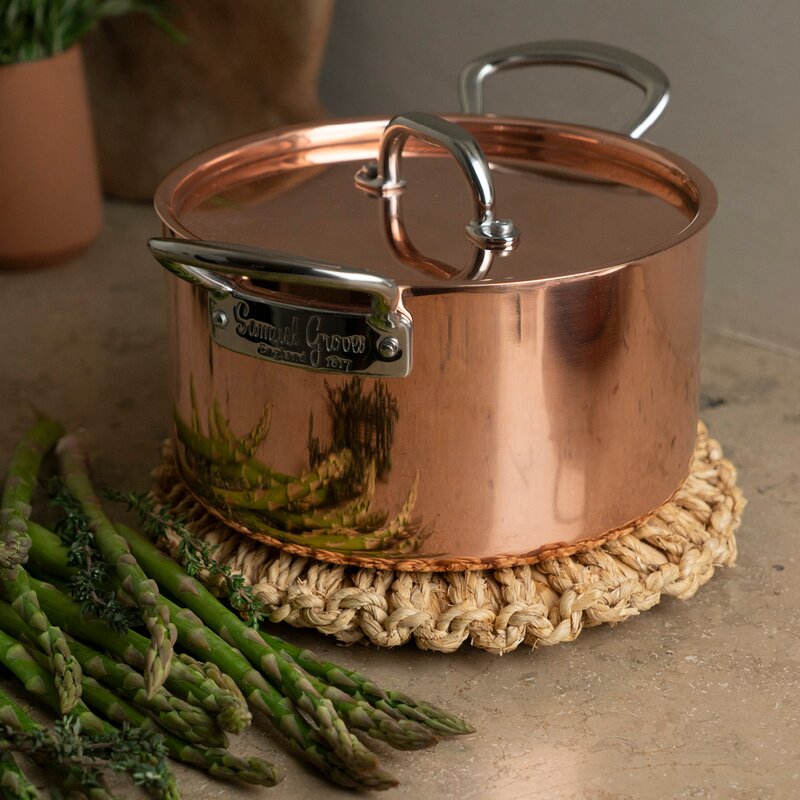
See price & spec →Samuel Groves Copper
The responsiveness of copper with a bonded base for modern hobs. For cooks who want instant control over delicate sauces and sugar work.
See price & spec →A small set, with a reason for each pan.
Begin with an all-rounder. Add a pan when you keep noticing a job your current ones don’t do comfortably.
The Everyday Pair
Covers most daily cooking — the two pans you’ll reach for first. Add a lid for the saucepan.
The Balanced Kitchen
Almost all home cooking in four vessels, from browning to one-pan meals to everyday boiling.
The Serious Cook
Every technique to hand — searing, slow cooking, braising, stock and pasta.
The Japanese Kitchen
Everything for rice, hot-pots, tempura, tamagoyaki and steaming.
Good care is a small daily habit.
Choose cookware whose upkeep you can keep. Get these right and your pans will outlast almost everything else in the kitchen.
Heat stainless before oiling
Heat the pan, turn it down, then add oil and swirl. Waiting closes the pores so food is far less likely to stick — repeat each time, as washing reopens them.
Season iron & carbon steel
Before first use and after washing, wipe in a little oil and heat it in. This builds the natural non-stick patina that improves with age.
Soft utensils on coatings
Only wood, nylon or silicone on non-stick and ceramic. Metal scratches the surface and shortens a coated pan’s life.
Keep acid out of bare iron
Cast iron, carbon steel and unlined copper are reactive. Cook tomato, wine and lemon in stainless or enamelled pans instead.
Low heat for coatings
High heat degrades non-stick and can discolour it. Keep coated pans to low–medium, and never heat an empty non-stick pan.
Never soak iron
Hand-wash cast iron and carbon steel, dry thoroughly and re-oil lightly. Soaking or the dishwasher strips the seasoning and invites rust.
Match pan to hob
Use the ring that fits the base. An oversized flame up the sides wastes energy and can warp thin pans or damage handles.
Mind copper linings
Never heat copper empty — a tin lining melts around 230°C. Hand-wash gently and have tin linings re-done when they wear.
Dry well, store safely
Even stainless can spot if left wet. Dry pans and lids, and stack with a cloth or protector between coated surfaces to avoid scratches.
For full guidance across every material, see our care instructions.
Will it work on induction?
Induction hobs only heat magnetic materials, so the base of the pan has to be magnetic.
Works on induction
Not without a magnetic base
Six myths that lead you astray.
Non-stick is best for everything
It’s the easy choice for eggs, but it can’t brown or make a pan sauce, and it wears out. A stainless or cast iron pan is more versatile and lasts far longer.
A boxed set is better value
Only if you use every piece. Two well-chosen pans usually beat a ten-piece set of pans that sit in the cupboard.
Cast iron heats evenly
Iron is actually a modest conductor — it heats slowly and can have hot spots. Its real strength is holding heat once hot, which is why it sears so well.
More layers means a better pan
Five-ply isn’t automatically better than tri-ply. What matters is the thickness and quality of the conductive core, not the layer count.
Copper is just for show
Copper has the finest conductivity of any cookware — it responds to heat changes almost instantly. It’s a genuine tool, though a costly one that needs care.
Heavier is always better
Weight usually means a good core, but a pan must be liftable when full. Woks and yukihira pans are deliberately light for a reason.
Take this to the cookware counter.
A specification is a starting point. A few practical checks help you choose a pan you’ll still enjoy after the first month.
I know the main job this pan will do.
I’ve chosen the material for how I cook and care.
It works on my hob — I’ve checked induction compatibility.
The size suits my household, hob rings and storage.
I can lift it comfortably when full, and the handle suits me.
I know the oven-safe temperature and whether the lid’s included.
I’m happy with the upkeep (seasoning, hand-washing, re-coating).
I’ve checked the guarantee, price, delivery and returns.
Cookware buying FAQs.
Straight answers to the decisions buyers ask about most.
What cookware should I buy first?
Stainless or non-stick — which do I need?
Why does food stick to my stainless steel pan?
Cast iron or carbon steel — what’s the difference?
Is non-stick cookware safe?
How do I know if a pan works on induction?
What’s best for cooking pasta?
Do I need a full cookware set?
How do I season a cast iron or carbon steel pan?
Can cookware go in the dishwasher?
What is a yukihira pan, and what is a donabe?
What’s the difference between a frying pan and a sauté pan?
Is copper cookware worth it?
Why is my pan cooking unevenly or warping?
How long should good cookware last?
What cookware do professional chefs use?
The language of cookware.
- Clad / multi-ply
- Layers of stainless bonded around a conductive core (tri-ply, five-ply).
- Core
- The aluminium or copper layer that actually spreads the heat.
- Anodised aluminium
- Aluminium hardened by an electro-chemical process for durability.
- Seasoning
- A baked-on layer of oil that gives iron and carbon steel a natural non-stick surface.
- Patina
- The darkened, seasoned surface that builds on bare iron with use.
- Reactive
- A metal that reacts with acidic food — bare iron, unlined copper, raw aluminium.
- PTFE / non-stick
- The coating that gives easy release; keep to low–medium heat.
- Tin lining
- The traditional interior of copper pans; re-tinnable, melts around 230°C.
- Enamelled
- A glass coating over cast iron — non-reactive and no seasoning needed.
- Sauté pan
- A wide, straight-sided pan for browning then simmering.
- Hob compatibility
- Whether a pan suits gas, electric, ceramic or induction; induction needs a magnetic base.
- Detachable handle
- A clip-off handle so one pan goes hob to oven to table and stacks small.
How we put this together.
This guide combines manufacturer documentation, established cooking references and JKC product information. Recommendations are practical starting points, not a laboratory test or a ranking. Individual pans vary — the maker’s instructions and current product specification take precedence. Product examples illustrate different choices, and JKC sells the linked products.
- Japanese Knife Company: cookware materialsMaterial families, heat behaviour and care.
- Japanese Knife Company: general care instructionsCleaning, seasoning and storage across materials.
- CristelMulti-ply stainless construction and removable-handle systems, made in France.
- SkeppshultSwedish cast iron, heat retention and seasoning care.
- KyoceraAdvanced ceramic non-stick and low-oil cooking.
- Samuel GrovesMulti-ply copper and induction-ready construction.
- JKC cookware rangeCurrent specifications, sizes and hob compatibility.
Starting prices are indicative and were confirmed against the shop when this guide was written — always confirm the current price and availability before ordering.
The right pan should feel right on your hob.
Visit a Japanese Knife Company shop to compare weight, balance and finish — or tell us what you cook and we’ll help narrow the choice.